Does Sub-Maximal Training Lead to Submaximal Results?

Training for endurance sports is generally a question of efficiency. Efficiency of good performance though is a product of replicating competition and it’s demands. Competition in itself is performed at maximal or close to maximal intensity. This leads to a question about excessive training volume, lower intensity sessions and how a training programme is structured. “Should all training be maximal or close to competition pace?” So do swimming, cycling and running as well as gym training have to be challenged at a maximal of close to maximal level to administer improvements and can excessive amounts of training hamper their progress?

Swimming out of all of the disciplines is a sport traditionally born out of efficiency of movement. Streamlining and body position can make a difference of seconds and that can mean a matter of places at the top level. Race pace for sprint swimmers is as much a question of efficiency as physical capability, simply stated you cannot have shear power with no efficiency. That said form will breakdown for two reasons laziness (or poor coaching) and fatigue. Fatigue in nature is a product of inefficiency and broadly speaking is a result of the level of conditioning not being sufficient to maintain a suitable technique. Indeed the fatigue factor is relevant also to cycling and running where inefficiency in technique leads to further fatigue as ideal body position cannot be maintained.

Running in itself is governed by form. Poor running style though has the element of impact with the floor to be concerned about- something that swimming and cycling do not have. Structurally this is harder for the body to deal with as there is greater stress on the joints and connective tissue. This brings in to the equation the role of core stability, reactive strength and the ability to maintain form with good structural strength. Many new runners find the demands of running plays havoc with their joints- specifically the lower back and the knees. Both these areas have a limited amount of movement in them and predominantly need to be trained for stability. The ankles and the hips need stability though they also need a suitable amount of mobility. Without sufficient mobility or movement in the joint forces may not be transferred in an efficient way leading to overuse- specifically in the areas that have limited mobility. This highlights that excessive training volume in the form of too many miles or time spent on the road can have a detrimental effect on the body. Simply said if you are training for competition sub-maximal training should not be too long in volume. Favouring shorter runs more often is possibly a more efficient way of organising volume even as you build up the amount of training over a period of time. Recovery runs also should not be excessive in volume if your goal is to run quicker.

Cycling in turn is slightly different again. Cycling does not have the elastic plyometric bounce and impact that running has as you shift from leg to leg. Maximal training in this case can replicate competition at race pace or slightly above and below. While there is a need for training volume cycling and swimming are less destructive on the joints as you look to build efficiency of the energy systems.

As with most training excessive volume is what causes overuse injuries, I tend to term these “junk” miles and consider that you need to be training to gain ahead of just training. In all forms of training there is a need to cultivate efficiency of technique and energy systems efficiency. Technique breaks down under intensity and is where you also see injury. The key is being to maintain a sufficiently high intensity so you have carry over to performance, be it a tempo or interval session. Too much recovery work or also what some may call “base building” may end up blunting higher intensity sessions as cumulative fatigue holds back intensity, especially in running. Commonly, winter training is guilty of this as it sacrifices intensity for sheer volume. Cyclists commonly base build through the winter though is a phase of training that can be greatly helped by spikes of intensity at regular points. This means that race pace is being challenged and therefore you are training yourself to move faster. Swimming training volume is an area of debate- longer sessions should be technique refinement led and pace should not be ignored if faster times are sought.

With all three disciplines it highlights the point that slower sessions should be performed but they should be technique led, for beginners two sessions a week is ample but for the more advanced with good technique and structural strength then once a week is enough for energy systems eficency- train with intensity as when it comes to race day not knowing how quick is quick means that your overall result may suffer.

A Wobbly Concept

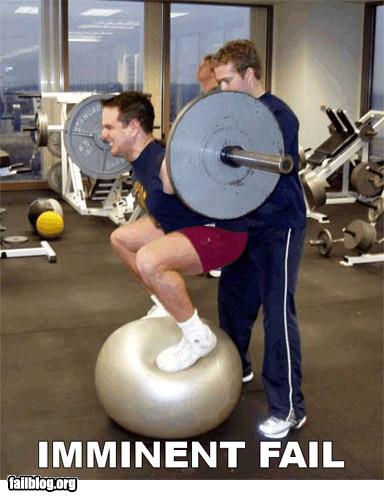
Unstable surface training has become a popular concept in fitness training. Vibration platforms and bosu boards are becoming mainstays in commercial gyms as they try to entice their customers with varied forms of training based entertainment. Is it all a waste of your time though?

Initially, it is important to look at the background of where these methods of training have emerged. Unstable surface training has progressed in to the “training” environment due to the greater role that physiotherapy and rehabilitation has played in the industry over the last 10 years. To understand further it is important to look at training fundamentals as well as how these methods apply to injured and non-injured trainees.

The body as a whole is a series of joints working through the ankle, knee, hip, back and shoulder. Each of these needs an adequate supply of mobility and stability/ strength. If we have comprimised stability at one of these areas it can cause injury- not necessarily though where there is a lack of stability but at a different point in the body. For example, poor hip stability is associated with knee pain. If mobility is lacking in a certain joint again pain may be felt in another area of the body, for example a forward rounded shoulder posture indicates poor mobility in the upper back (thoracic region) and can cause issue with mobility at the shoulder joint.

The concept of unstable surface training indicates that more muscle mass will be recruited if unbalanced. Is this the case though? Two things recruit muscle mass, speed of movement and load. Unstable surface training comprimises both of these as you cannot either move as quickly as possible or indeed safetly load maximally. Muscular recruitment is task dependant and therefore only relevant to the movement being performed.

Unstable surface training for the lower body is more relevant to a rehabilitation based environment. Indeed it has no real carryover for those looking to enhance performance if uninjured (Cressey, E.M. et al. J Strength Cond Res. 2007 May;21(2):561-7). When we provide an unbalanced environment for example a lunge or step up on a vibration plate or a single leg squat on a bosu a number of things will happen. Firstly, the body will aim to maintain stability, the mechanism for this is that the body will start to tighten up. Is this a good thing? It is interesting that most vibration trainers start pointing at the torso area when discussing the benefits of this type of training when really the ankle will tighten up first and shut down mobility to maintain balance. As discussed before if mobility is shut down at a joint then it can casue undesirable movements from joints further up the body to maintain balance. Usually this will be at the knee which is an area of massive stability (it is a hinge joint after all so does not like excessive rotation- which unstable surface training can encourage). If you consider how force is applied to the human body from a day to day perspective, very rarely does the ground move beneath us. Indeed we have to be able to move across varied terrain (for example, cross country running). This though is not through a full range of motion at the ankle, hip or knee. Indeed the forces are reactionary in nature, short lived and through a limited range. Most forces will act on the human body above the floor either by collision or by changes in loading or centre of gravity- consider falling over and trying to stop it happening- you tighten up from the top down rather than the bottom up.

When is this training relevant though? Well looking to improve proprioception in the lower body is vital- escpecially on return from an ankle injury. Building eccentric strength and the ability to absorb force are fundamental qualities of a rehab programme intially before returning to more advanced forms of training. After this the focus moves towards the transferance of force and power generation ultimately in a multidirectional format. Methods of unstable balance training could be argued as a valid as entry point for rehabilitation. Once the ability to control load has been assessed to be suffcient to perform more advanced training under increased training loads then unstable surfaces lose their priority in the hierarchy of needs. The evidence for these methodologies though is stil not resounding even in rehab situation indeed some studies have even shown an increase in injury risk post unstable surface training intervention (Soderman, K. et al., Knee Surg Sports Traumatol Arthrosc. 8(6):356-63. 2000).

For the upper body there is an improved arguement. Due to the nature of the shoulder joints need for stability and the relevance of how forces act on our extremeties being able to react to unstable loading can be beneficial. This is not saying that one legged/ one arm vibration plate shoulder press is the way to go. More that unstable loading for the shoulder joint can be a challenge which encourages force production and torso stability without comprimising the role of the shoulder joint and it’s range of motion. This would not be a priority exercise in a programme but performing press ups (weighted vest for load) with the hands on the unstable surface may be relevant for scapular and torso control as an assistance exercise or indeed dynamic core drill.

How does this apply to the average exerciser or indeed even the elite athlete? It’s pretty much the same. Most people need enhanced strength- this is not gained by balancing as it comprimises load and speed of movement. Strength and it’s varied componenets such as power and endurance are the fundamental capability we are looking to develop as well as the ability to move and perform exercise in a posturally correct way. Enhancing the quality of movement is key and this is done by balancing mobility and strength in tandem usually against resistance which includes your body weight.

So why the prevalance of unstable surface training in the fitness industry? These concepts are relevant for some people, the injured and the completely detrained. If someone is new to training then unstable surface training may help them improve- but doing anything will help them improve from a strength perspective, escpecially if it is delivered in a structured format. If they increase participation then from a “health” perspective it is probably better then doing nothing. This form of training provides “entertainment” away from other more traditional exercises- however as you can see it is a regression in training rather than a progression as although changes in exercise complexity may make you feel like you are working harder in truth you may be comprimising your progress.

How to Pick The Ultimate Trainer…

How do you decide what fitness trainer is for you? With the varied choice of personal trainers, boot camps and classes the difference in standard of practitioner can be pretty varied. Indeed these in my mind are the questions you need to be asking…

What Qualifications Do You Have? This seems to be one of those factors which is overlooked. A certification does not necessarily mean someone is qualified to write  exercise programmes. Personal trainer courses now demand no longer teaching time than it takes to become qualified to teach a circuit training class or aerobics. Why is this important? The advice that you get from your trainer needs to be scientifically backed and they need to explain why you are doing something. When it comes to your body exercise prescription is pretty much as important as medicine and in turn if prescribed incorrectly it can have implications for your health. When it comes to how qualified a trainer is there are a raft of varied qualifications from degree level to basic short course certifications. The top-level individuals I have worked with have continuously strived to improve their qualifications through their career- no matter what their starting qualification. A degree does not necessarily prove competence however, it does prove that an individual has invested in their education beyond a weekend certificate. Buying a new piece of equipment or starting a boot camp does not mean someone is well qualified indeed it is understanding how these things affect the individual you are training. A lot of the time a businesses marketing will cover short comings in qualifications- in the long term the good rise to the top while also rans stay on a level.

What Experience Do You Have? 10,000 hours is generally set as the bench mark for excellence for expert performance. This applies to 10,000 of correct effective practice. Ten years of experience does not quantify what that persons level of professionalism is, indeed without an ongoing process of continuous development and reinforcment of poor programming then this individual may be a weaker trainer than the average new coach. Find out specifically what an individual has acheived in their career. There is such a thing as a good generalist- if an individual can talk with direct reference about people that have achieved their goals then this will help you determine their level of expertise. Ask where they have worked and how those experiences have shaped their approaches- have they worked in associated fields such as nutrition, sport or medicine. The wider a trainers field of reference then the more realistic advice you are going to get when it comes to finding out what programme of exercise is right for you.

What is their “Fitness Product”? There are a range of classes and gym based/ equipment led things to take you to your fitness and health goals. Ask the question though is what this person selling the best thing for me? With a lot of current trends you could consider a lot of current fitness products as “activity” or general “exercise” such as your average aerobics class (Zumba included) or spinning session (useful as a calorie burner if you like biking). Boxing based fitness and circuit training can be useful but most of the time I find this is trainer led- these sessions are usually the most accessible for beginners though there main job is to smash the participant in to the ground and the programme is not necessarily personalised. Here exercise form suffers and to me it is not smart exercise. Bootcamps are a current trend gaining speed in the fitness market- their problem is they suffer a pile them high mentality which means that exercise form is not always policed properly. Once sessions run to above ten it becomes pretty hard to make sure everyone is doing the right thing.

Personal training and small group personal training in my mind are the stand out product. The reason being is that exercise can be prescribed in a sensible format in a measured fashion. As well as this it is possible for the client to be coached at a suitably high level, for more information check out what we do at Results Fast.

Price? Probably the most contentious issue in any type of business, what should you pay for training. Well trainers products and prices vary. Is one trainer worth 10K a week or £160 an hour? Does more expensive mean better? Sometimes yes, but looking from a realistic standpoint it depends on your needs. The question is how confident do you feel in the person to take you towards your fitness goals. Looking at their qualifications, experience and product does it limit you in anyway? Sometimes the trainers availability is an issue. I tend to think you need to buy in to a programme that is progressive and gives you the opportunity to acheive what you want.

Do you want to lose weight? Well do you get a full nutrition plan plus at least 3 sessions of training a week- if you don’t your results will be limited.

Do you want to get stronger? Are you lifting progressively heavier weight on a periodized programme for 3-4 sessions a week? If you don’t your programme will be limited.

Do you want to run a marathon? Has your running form been screened for your specific structural tightnesses and weaknesses, are you running 3-4 times a week? If you don’t your progress will be limited.

Are you trying to rehab an injury? Have you had a full structual screening with a person who has worked with your condition and has access to specialists that can be refered to if need be? If you don’t your progress will be limited.

Of course this paints a picture of an ideal traning programme- the truth is though you can get great results with the right programme being realistic though this depnds on how much time you a willing to make available. If 90% of gym members turned up at their training centre then they would have to close. The “box” gym’s service is as a venue for gym equipment rental, even though they pretend their product is training, it is collecting memberships which pay their bills.

Training led businesses are the future of the fitness industry and those trainers that are investing in improving their service and programming will excel. So when it comes to choosing what works for you consider what you want to acheive and how you want to do it. Going for a stroll on a stepper or cross trainer may be what you are doing now but ask the question- has this really helped me towards my fitness goals. The likely thing is that there are things you want to acheive but your time, money and organization limits what you can do. Find the product that can combine the flexibility you need for the right price with a realistic approach in mind for your fitness goals. If you are frustrated and feel you need to do more then decide if fitness is your priority. If it is find out how to acheive what you want and see if it can fit in to your life.

You are probably kidding yourself if you think one personal training session a week and a spinning class is good enough for any fitness goals. Indeed we believe at Results that anything below 3 hours of activity a week is not really taking you fitness forward. Bear that in mind when you approach your trainer/ fitness professional and ask them what you need to do to acheive your goals- whatever they are and whatever your fitness levels….

Hamstrung- Effective Hamstring Training for Performance

Both runners and cyclists in the past have considered the quads to be the primary muscles to develop for performance commonly leading to overbuilt, dominant anterior leg muscles.  

The hamstrings are among the muscles responsible for running and cycling fast as they are involved in both knee flexion (bending and hip extension (torso straightening at the hip)). The hamstrings are also key decelerators- indeed the faster you can stop the quicker you can move again.

The Anatomy of Movement of Running and Cycling.

Understanding the hamstring almost needs a full anatomy lesson in what happens during movement and specifically how energy is transferred. More specifically the elastic power transferred from between one leg to the other leg during normal gait. Running in this case is different to cycling; running is a movement which relies upon elastic power being converted to kinetic power before being converted back to elastic power (think as you move from leg to leg).

In running the hamstring is stretched as the opposite leg swings forward, the pelvis maintains position as the hamstring stretches away from the torso trying to stabilize against rotational forces (this highlights the role of suitable core strength for runners who have symptoms of hamstring pulls or sore lower backs). As the foot transfers through the gait cycle there is a changing of emphasis of the muscles that are recruited. As the toe pushes of there is a transference in muscular recruitment from the hamstrings, glutes and erector spinae (back) to the abdominals, iliopsoas and the quadriceps muscle group. Broadly speaking this is a transfer between the muscles at the back of the body to the muscles at the front of the body. If the pelvis is in an incorrect position away from neutral it can make the transference of muscular recruitment difficult. Why? The torso has to stabilize against rotation and forward leaning. This can be seen in runners who lose control as they run, simply elastic energy transference is affected and the individual finds it hard to bring the swing leg through in front of the body. If as they push off on their toe there is too extreme a level of backwards movement (or the back hyper extends) it will result in the forward movement of the pelvis (often termed anterior tilt), this highlights that the knee does not need to travel backwards far past the hips in order to maintain pelvic stability. Great sprinters show this knee and hip position, if efficiency is leaked over 100 metres it can mean a difference of seconds. While in distance running efficiency is vital for quick times it is also vital for injury protection. Running in an uneconomical way can lead to poor joint position that loads the muscles and connective tissues and can ultimately lead to injury. If the hamstrings are tight it can pull the pelvis downwards posteriorally, tightness in this case limits the range of movement of the leg and limits stride length. If not strong enough anterior pelvic tilt occurs causing hyperextension at the lower back and possible back pain. Both may be related to hamstring pulls but for different reasons.

Cycling is different, when seated the pelvis is affectively fixed in a different position. As you do not have the elastic challenge to stability and transference from leg to leg, efficiency and leg power have to be built within relative few changes in environment as the movement is essentially closed chain. There is a need though to maintain pelvic stability and resist rotation (as in running). A stable pelvis leads to economical movement of the legs and therefore efficiency on the bike can be maintained. It highlights why leg power or strength is only task specific- most great sprinters would not come close to setting the world of time trialling on fire and vice versa.

The Myth of Sports Specific Training for the Hamstring.

So does this mean hamstring strength is trained differently? Well no, technique for runners and setup and technique are vital for both runners and cyclists. Beyond that though training the hamstring in itself is about training not just that muscle but the muscular balance between all the muscle groups that act around the hip and knee.

Most movements that operate through the hamstring tend to be ballistic- this highlights the necessity of the hamstrings to be able to control rapid lengthening. Hamstring training should initially be eccentric in nature; this means that during training there is an emphasis on controlling the lengthening of the muscle. This should also be multi-joint so that the muscles are recruited as a unit, not independent of each other- this is often where injury or overuse occurs. In regard to injury occurrence poor warm up procedures are blamed for hamstring pulls and strains. Type of warm up matters but specifically stretching the hamstrings effectively turns the muscle off, this increases the chance of injury as the muscle cannot lengthen under control.

Initially exercise selection to develop strength should consist of exercises such as stiff leg deadlifts, single leg deadlifts, step ups, and reverse lunges. These can progress towards walking lunges, cable hip extensions, glute ham lowers/ negatives and forward lunges. Beyond this technique training for both cycling and running can be reinforced. Bike work needs to be on the bike, variation of resistance can be used.

Dynamic hip mobility exercises for both cyclists and runners is important. Lack of hip mobility is a major cause of many hamstring problems. Without proper hip mobility the leg will not be able to work through the full range of motion. This limitation will eventually lead to flawed mechanics especially in a fatigued state as more limited ranges of movement will be worked through. These drills should be incorporated daily as part of warm-up or cool down and initially may be performed for posture correction reasons.

On a single leg the abductors and adductors play a major role in the stabilization of the hips. Resisted hip abduction helps strengthen the glute medius (vital for knee tracking). If they are weak or not coordinated with the hamstrings more strain will be placed on the hamstrings. Lateral resisted side steps with a rubber band placed above the ankles or  the hips can be utilized as a warm up and cool down drill. This is quite effective for cyclists who can develop dominance in certain muscles leading to faulty knee tracking.

As for running, stair and gradient running is an efficient way of emphasising a high knee lift and powerful drive on toe off. Hill sprinting at a 15-degree grade provides an excellent means to develop good top speed mechanics. It is virtually impossible to overstride sprinting up hill and helps develop an efficient leg pick up from the hip flexors. Low hops and jumps serve to facilitate muscle stiffness which is more important for running than cycling. Stiffness does not mean necessarily mean tightness it means stability and quick transfer of movement, the opposite of stiffness would be the leg collapsing at ground contact. The emphasis here should be on the knee being slightly flexed with quick movements and low ground contact times. The key is in the ability to absorb force efficiently and transfer quickly.

This article has highlighted that subtle differences exist in the conditioning of cyclists and runners though there are more similarities especially in the gym that leads to optimum transfer to better performance.

Train to be Better- Not Just Tired…

 When exercising we all want to be pushed. Indeed fatigue is a good thing. Fatigue effectively shows that we are working at our physical limits for a given attribute. However, the issue I have with higher repetition work is that often form is compromised. When form is compromised the body places undue stress on its joint structures. For example, press ups- the lower back often drops under fatigue putting strain through the lumbar spine as well as flared elbows putting excessive strain on the AC joint at the shoulder.

It happens on lower body exercises as well- excessive flexion of the lumbar spine when performing exercises such as Burpees as well as more fundamental exercises such as squats and lunges for high repetition.

Now some people may say this is reflective of “fitness” (which in itself is a highly general term and can mean a lot of things). Ultimately though fatigue will mask function if too extreme- indeed fitness for a given parameter is the ability to resist fatigue compared to it being the factor that ultimately ends the given exercise.

Training emphasis should always be on correct form ahead of fatigue. Endless repetitions of poor fatigue can cause poor movement patterns and ultimately injury- don’t compromise what you do to just feel “the burn.” Training is about making yourself better be it strength or cardiovascular- endless repetition in an incorrect way does not emphasise good training. Remember you are looking for the best possible result with the least possible effort- once you have achieved what you need to in a session then excessive work will generally fatigue you unnecessarily.

Experiments in Fat Loss: Part 3…

While this follow up was ment to come sooner due to a pretty stressful house move I have not had much time to write. That said it was great timing for the final week of the 28 day lean down to finish the week before we moved. The 2 previous posts of how the diet and training is set up are explained here:

Experiments in Fat Loss: Part 1…

Experiments in Fat Loss: Part 2- Cheating and Training

My final weight was 92.8kg on the final Friday- an overall weight loss of 5-6kg in 28 days (starting weight was circa 98-99kg). That said on rehydration the weight came back up to 94kg three days later with the inclusion of a larger amount of carbohydrates. This sort of shows the large scale variability that using scale weight can provide when using it as a guide to weight loss- this is even more prevelant for females who’s hydration state can fluctuate during their monthly cycle. Skinfolds came down around 20mm in 4 weeks placing my “new” body fat at just under 15%, this was agreeable though hitting the gold standard of sub 10% may be the next target.

So what are my overall reflections for this period of training and nutrition? Firstly, nutrition needs to be perfect for the ideal result- the final week was hard from the dieting perspective. I have performed low carb plans before though the problem comes when you start to feel devoid of energy, you start to feel ill or your training leaves you feeling light headed and weak. This sort of happened to me around the week 3 to 4 transition. To me it highlighted the neccessity to consume the right amounts of food and to keep the right type of fats in your diet. Simply speaking I felt rubbish in the last week and slipped up on the food front. At the same time this is a lessoon in perserverance- 28 days is a good amount of time to perform a lean down. Could I have gone out to 6 weeks? Well by the end of it I was pretty much in to the swing- focus has an addictive quality and it is important to understand this and manage it appropriatly. As I say to my cleints a diet is a short term fix, it is not healthy, it is a form of nutrition that often removes certain food groups though it can cause a desired result. The addictive nature of dieting often is seen in the results escpecially if things go too far.

Lifestyle is also another major factor. I feel that that organization and structure provides the best environment for fat loss. That means making the right foods available at the right times. Making your lunch and taking it to work seems to be an alien concept for a lot of individuals I work with. Simply it provides the control to have a healthy lunch without giving in to the chocolate bar or fizzy drink that you may pass on the way to the shops (if you have to buy your lunch). If you are busy obviously this squeezes the time to be organized in but finding time to plan is vital for success in fat loss as it is in any walk of life.

Sleep is another vital component. I will probably get hate mail for this but 6-7 hours a night is as much as I get on a good night. While increasing my work commitments in the short term you notive that with training it is harder to recover and strength levels are reduced. Comparing the body to a car if nutrition is petrol to your body then sleep is like the air in your tyres- you are not going anywhere quickly without it.

I used some pre-workout supplements before training, I varied the source to analyse the effect they had. While not wanting to actively promote any specific brands one of them high in caffeine and a hundred of other things provided a useful push to training early in the day. While not adverse to these products I am not a fan of their loading protocols. Simply anything packed high with stimulants such as caffeine can have addictive qualities as well as building up your tolerance to said stimulants (these were all of the shelf products). If you overload on these type of products it can leave you a bit amped up which is not always good. One point that I would like to make though is that these pre workout supplements where great when feeling fresh after a good nights sleep. Using them when tired though was a bit of a disaster, in fact one of them made me feel pretty rough. All in all it is an area of fat loss nutrition that I need to be sharper on so I intend to investigate these products a bit further and their advantages and disadvantages.

Experiments in Fat Loss: Part 2- Cheating and Training…

Two weeks in to a low carb 28 day blitz and quite frankly I am suprised how easy I found it. Cheat day proved to be the highlight of the week and I found after two weeks of focussed eating that I didn’t really want to go overboard from generally eating bad stuff.

Every week there is one day where on this plan you get a clear day of eating, week one I pretty much absorbed anything edible but as I approached week 2’s cheat day I just thought going extreme was not necessary. There is a scientific reason behind these cheats or what are often called “refeeds.” The idea is that by increasing your consumption (primarily of carbohydrate) on these days you effectively restock your muscular carbohydrate stores.

Why is this important? Firstly, dropping the amount of energy in your diet can sometimes slow down your metabolism- this is partly a method to conserve energy. This is precisly why individuals who regularly cut calories effectively will yo-yo with their weight. Secondly, we need to preserve muscle mass- training on a refeed days gives me the best session of the week and I will refer more to this below in regard to training.

There was one day mid week where I was pushed energy wise- I added 50g of carbohydrates to one of my meals, again understanding that I had consumed circa 100g of carbohydrates for the day meant that this could be included, never the less though it was post training so this refeed was at least going to help recovery.

The day after my refeed (Sunday) was where I found I had most cravings- specifically for sugar. It didn’t help that when going out to watch the Rugby that there was a table full of Dorito’s, dips and doughnuts. Regardless of the rugby all I could do was watch people graze on food while I ate about 5 pieces of carrott. In all seriousness though I can see why social support is a positive thing when looking to reduce body fat! In my mind tough as it is- this is 28 days of focus to see what gives on this eating plan. Why take 6 months to do something when you can do it in 4 weeks?

What training plan am I following? The first question (or assumption) someone suggested to me was “You are mainly doing cardio right?”  Well no.

The gym based programme I am doing is mainly a strength/ hypertrophy crossover. The reason being is that I want to preserve as much muscle mass as possible during this period of time. Also, I am conscious of strength levels reducing- never good.  In to the mix with this goes one session of steady state CV (ususally a hill/ undulating run of around 30-40mins) and a full body low rep circuit style session (performed in week one not in week 2 due to time commitments). I am using an upper body session, a lower body session and a full body session- see below for the full breakdown:

Day 1

Upper Body.

A1 Pull Ups 5 x 5

B1 Bench Press 4 x 5

B2 Bench Rows/ Seated Rows 4 x 6

C1 Single Arm DB Shoulder Press 3 x 8

C2 Cable Face Pull 3 x 8

D1 Side Lying External Rotations 3 x 10

D2 Tricep Pushdowns 3 x 20

D3 Hammer Curls 3 x 10

Day 2

Lower Body

A1 Deadlift 5 x 3

B1 Bulgarian Split Squats 4 x 8

C1 Kettlebell Swings 4 x 20

D1 Ab Roll Outs 3 x 12

D2 Side Plank 3 x 12

D3 Hanging Ab Curls 3 x12

Day 3

Full Body

A1 Front Squat 5 x 5

B1 Speed Deadlifts 3 x 10 @ 60% Max

C1 Chest Press 4 x 6

D1 Weighted Press Ups 3 x 8

D2 Trx  or Inverted Rows 3 x 10

E1Walking Lunges 3 x 12

E2 Rear Delt Flys 3 x 12

F1 Cable Torque Press 3 x 30 secs.

All in all what did all this organization lead to. Well as discussed in the previous post there was quite a hefty first week of weight loss. After the refeed in week one my scale weight settled at 96kg (down 2.8kg). At the end of week 2 scale weight had dropped to 94.5kg. At the start of week 2 and at the half way point my weight had settled to 94.8kg (a total of 4kg loss in weight).

In Part 3  I will discuss supplements, workout nutrition, methods of body fat testing.

Experiments in Fat Loss: Part 1…

March is a month that I am hitting a fat loss nutrition programme. Every time I do this I like to add some new things in to the mix to draw me back from the dry taste of repetitive protein meals. Some new bits I am bringing in to my plan this month (or as Claire calls them little “fads”) are a few things that I have used on and off before though with each of these I am making them integral parts of my nutrition plan:

Green Protein Powder- the rationale for this lies in variation of protein sources. There is also a bit of an “industry” movement to alkaline/ vegetarian based nutrition so I thought I would get involved to see what the fuss is about. While I don’t necessarily think going completely green is necessary using a pea, rice and hemp protein blend can be quite useful in varying protein intake sources while not necessarily consuming large amounts of peas and beans which can provide quite a bit of gastric distress. This takes care of your whole amino acid profile which nutritionally is a plus. The negative is that the taste and texture are not exactly A*. Well, with a minty taste I feel pretty good after consuming it- the process of getting it from my mouth to my stomach though makes me wretch. That said I have this with breakfast to get the day of to a good (healthy probably is a better descriptive than good) start with some sort of egg (boiled, scrambled, poached) concoction usually with chilli and spinach. Anecdotally I find the green protein quite light from a digestion point of view.

Lemon Juice and Water- This appears to be on every “celebrity” based plan. However, there is some valid sanity in the madness. Lemon juice can help reduce the glycemic index of food- a lower glycemic index means less extreme spikes in blood sugar. This means that there is less potential chance of calories in theory being stored as fat. Again- lemon juice is not the complete answer; however, I find it hard during the day when eating a higher protein diet to drink enough. At least with lemon juice pre-meal or snack I can stay hydrated with a carryover that may help reduce my body fat a bit more.

Almonds- Nuts in generally have a good correlation with fat loss based diets. The one problem I find is that 6-10 almonds can very quickly become half a pack. This is where in fairness mental toughness comes in to play and portion control. Nuts are generally easy to store and carry with you as a quick snack. I make this one of my mobile snacks especially if I know I may not get a chance to eat properly. In fact nuts and a protein shake are pretty much a default 5 minute meal between sessions or clients.

Coconut Oil- I have been using coconut oil for the last 6 months, coconut oil is solid at room temperature and is an alternative for cooking compared to vegetable or olive oil. It is predominantly saturated meaning it is often highlighted as unhealthy even though the calorific yield is slightly lower. Why is it a good alternative? The reason for my usage is that it is formed of medium change triglycerides (MCT). MCT’s have a better availability to be turned in to energy; in effect they will be metabolized quicker than long chain triglycerides. As I am eating light on carbs this could be handy. Of course not a complete fix but keeping fat intake steady has a number of metabolic benefits include maintenance of the immune system.

In the rest of the plan I am gunning to consume protein every 3 hours as well as some servings of vegetables or salad. In all it’s not that hard as long as you prepare at the start of the week. For instance I have my breakfast at 5am (I have a pretty long day), a shake and some nuts at 8am, a piece of chicken and a green salad at 11am, a tin of oily fish such as tuna, sardines or mackerel with more salad or vegetables (sometimes I may have an innocent vegetable pot which works quite well) at around 3pm and then an evening meal e.g. chilli and salad which is usually a bit too late (8pm), most of the time I will be training people till then.

This is not a maintenance plan and is only set up for 4 weeks but after one week  and 2.8kg of weight loss it’s going pretty well (probably a bit of the weight loss is water so it isn’t necessarily fat). Next article I’ll talk a bit more about my training and the highlight of my week- cheat day!